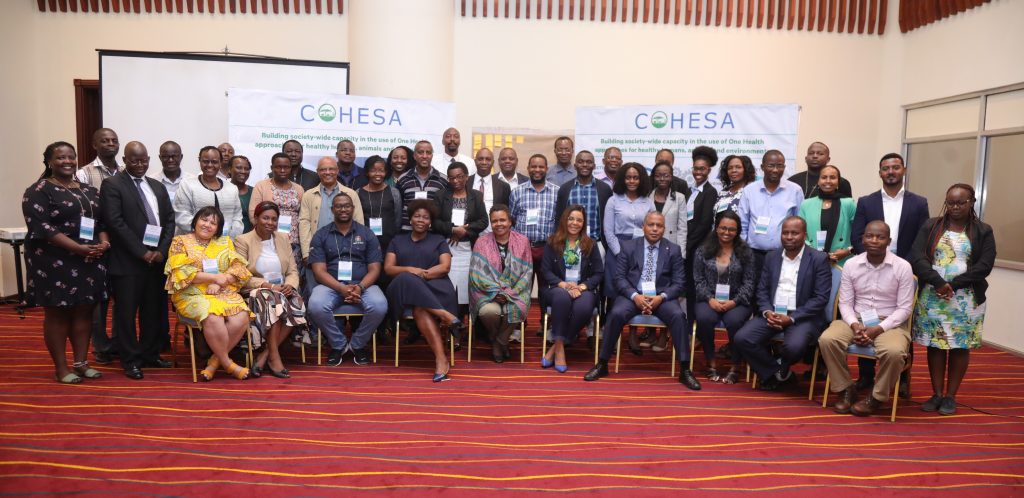
One Health (OH) stakeholders in eastern and southern Africa regions have rooted for establishment and institutionalization of OH platforms to enhance cross-sectoral collaboration and strengthen coordination between state and non-state actors in the regions. This was the main resolution adopted by the more that forty stakeholders attending a Regional OH Science Communication and Leadership Training Workshop held in Nairobi from 7th to 11th November 2022.
The five-day training-cum-study tour, comprising stakeholders from ten African countries, was organized under the auspices of Capacitating One Health in Eastern and Southern Africa (COHESA) project. The project aims to generate an inclusive research and innovation ecosystem that facilitates uptake, adaptation and adoption of solutions to issues that can be addressed by an OH approach.
It emerged, during the workshop, that inadequate coordination of OH activities and lack of decisive leadership are some of the key impediments to formulation and adoption of evidence-based OH strategies and policies.
Experts’ ineffectiveness to influence OH-related policies was another concern raised during the workshop. In keeping with COHESA’s objective of addressing policy gaps by increasing the relevance of OH research and policies, stakeholders were capacitated with requisite skills for development of impactful policy briefs.
“Policy briefs are powerful decision-making tools that provide advice or raise awareness on an issue. OH stakeholders and partners should utilize this tool to offer recommendations and influence policy actions in favor of interventions that address OH challenges,” said Mary Mbole-Kariuki, a Technology and Innovations Expert at the African Union Inter-African Bureau of Animal Resources. She challenged the participants to start building relations with stakeholders in the OH policy cycle within their respective countries.
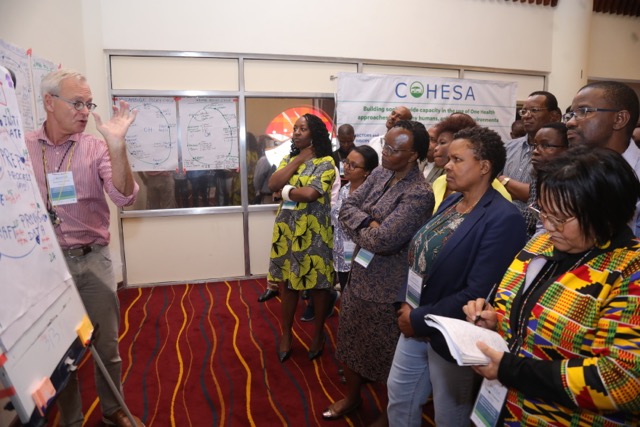
The workshop was part of a series of trainings whose goal is to equip COHESA partners with effective communication and policy advocacy skills that will enable them effectively communicate OH issues and solutions to non-technical audiences, including the media and policy makers. Project partners comprising key players from key line ministries (Health, Agriculture and Environment), academia, and research institutions, took part in the workshop.
The training also equipped the partners with effective media relation skills and enhanced their understanding of how media relations can enhance OH interventions and solutions. Through rigorous scenario settings and practice, the stakeholders demonstrated improved confidence in engaging the media and handling challenging media situations.
ISAAA AfriCenter Director and COHESA consortium co-lead Dr. Margaret Karembu called on OH partners to proactively engage the media as an important actor in addressing One Health related issues. “Look for opportunities for media interviews and talk shows to enhance relations with the media and sensitize communities on OH issues,” she advised.
The training also strengthened partners’ skills on development of responsive messages. Through a series of participatory exercises, participants also developed model OH organograms for their current or prospective national OH platforms.
COHESA multipliers, whose role is to drive and implement the project in their countries, were challenged to utilize the lessons learnt and recommendations, to build synergies towards strengthening operationalization of OH in their countries.
The project partners participated in an OH study tour for experiential learning on the outskirts of Nairobi City as the curtain came down on the experience-packed five-day event. The first site was at the interchange of two major metropolitan transport corridors located 5.6km south-east of Nairobi’s CBD. Here, partners explored the impact of rapid urbanization on biodiversity, and how wildlife-livestock-human interfaces increase chances for emergence and cross-species transmission of zoonotic diseases.
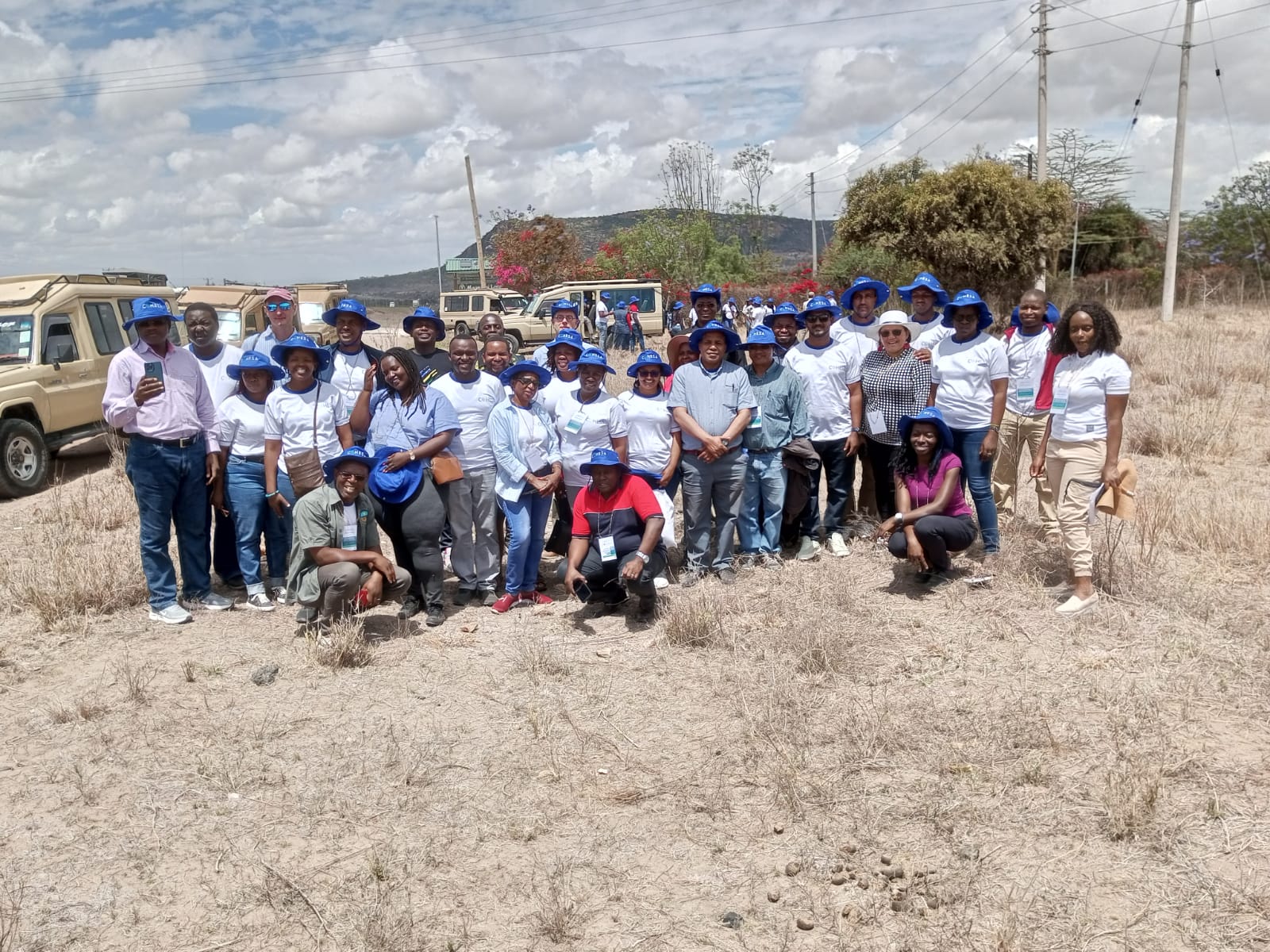
The next stop was at Mlolongo, a suburban village characterized by a dense urban population with a semi-arid ecology. This site presented an interesting example of a typical growing suburb where anthropogenic activities put pressure on land to produce vegetables to feed the urban population. It was a special site for COHESA partners to observe and interrogate any health risks presented by suburban ecologies that depend on polluted rivers and tributaries for irrigation of crops that get back into the city’s food systems.
“Anthropogenic pressures, including activities at a camel abattoir located not far from here, have created interfaces for concentration of wild animals and roaming dogs within this environment. This situation presents a risk for emergence of zoonotic diseases and thus a serious OH response is required,” observed Dr. James Hassell, an epidemiologist and wildlife veterinarian at the Smithsonian Institute of Conservation Biology.
The partners concluded the tour at ILRI’s Kapiti Research Station and Wildlife Conservancy located approximately 43km south of Nairobi. This is a 13,000-hectare facility for conducting research, promoting conservation and practicing commercial livestock ranching. The facility is a model for effective habitat conservation allowing coexistence between livestock and wildlife in the face of land fragmentation and other human activities that continue to threaten wildlife habitat. “At Kapiti, we want to show there is a sustainable way of managing wildlife and livestock together,” said Dr. Sonja Leitner, a Biogeochemist at ILRI.
Using the expansive ranch-cum-conservancy, scientists at ILRI are studying how livestock-wildlife interface can present a risk for disease transmission from wildlife to livestock. The experience at the ILRI facility was an eye-opener for COHESA partners to contemplate on human-livestock-wildlife interfaces. Overall, the tour presented a unique opportunity for partners to discuss appropriate OH interventions in the face of rapid urbanization and climate change.
The training-cum-study tour was organized by ISAAA AfriCenter and ILRI.
This article was written by Walter Langat, a communications associate at ISAAA AfriCenter