Peter Theuri
ISAAA AfriCenter
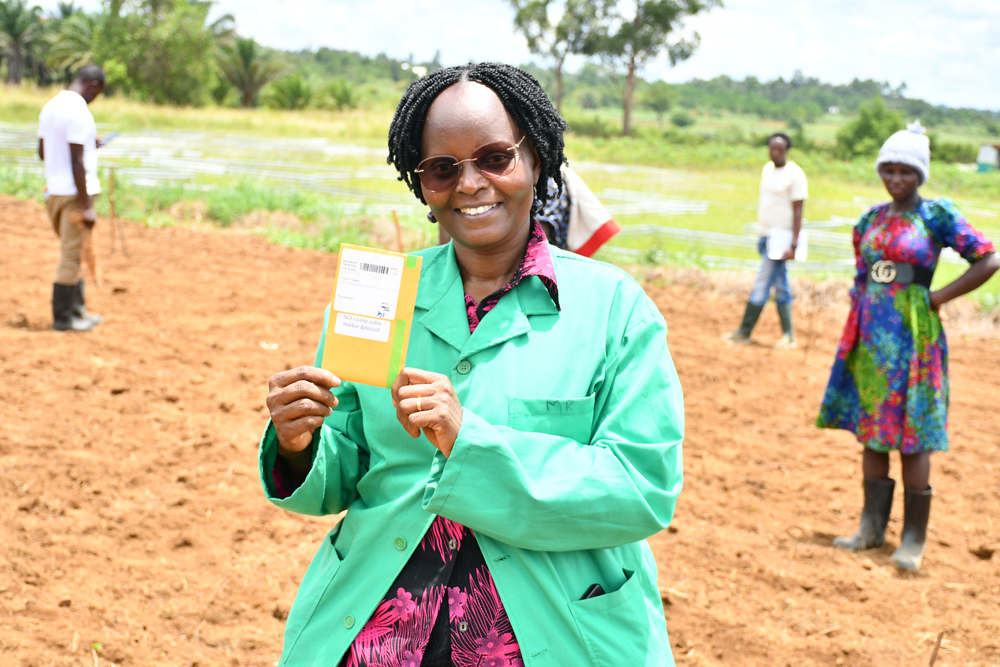
Dr. Margaret Karembu, Director ISAAA AfriCenter holding a packet of gene edited sorghum seeds ready for planting for demonstration purposes in Western Kenya.
Improvement of training and capacity building for researchers, strengthening of ethical oversight mechanisms, and enhancing data protection frameworks could go a long way in addressing gaps in biosafety regulatory frameworks, and in strengthening the path toward commercialization.
These measures alongside increasing awareness and engagement between regulators, researchers, and industry stakeholders, could significantly move the needle as Africa labours to maximise benefits from its research, which oftentimes struggles to create products that reach the market.
“A harmonized approach that combines training, governance, and collaboration will help translate scientific research into safe and impactful products,” says Dr Stella Irungu, Senior Research Scientist at the Institute of Primate Research in Nairobi, Kenya.
Dr Irungu, who recently attended a webinar on Integrating Regulatory Analysis into Biotechnology Research Proposals: Enhancing Translational Readiness, organized by Biotechnet II in collaboration with ISAAA AfriCenter, notes that researchers, across various disciplines, could move on a business-as-usual routine while unaware of key regulations and frameworks in the required detail, “as many tend to focus mainly on obtaining permits while paying less attention to aspects such as translation, application, and commercialisation of their research.”
In the webinar, ISAAA AfriCenter Senior Program Officer Dr Paul Chege made a presentation detailing key regulatory instruments in Djibouti, Ethiopia, Kenya and Uganda, including biosafety requirements, policy environment, institutional approvals, and the cost implications of compliance.
The aim was to support applicants from these countries to the ICGEB Biotechnet Collaborative Research Programme (CRP) Grants and related initiatives by strengthening their policy and regulatory clarity relevant to biotechnology research and commercialisation in East Africa.
According to Aderajew Adgo Tesema, a lecturer and researcher in biotechnology at Ethiopia’s Woldia University, the webinar provided the platform for a timely discussion.
“As we look toward more research in crop improvement and microbial biotechnology, understanding how to embed regulatory analysis into our initial proposals is essential for enhancing the “translational readiness” of our work. It provided a much-needed roadmap to ensure that our scientific milestones eventually reach the community level.”
He adds that, Ethiopia has made significant strides in establishing a legal framework, primarily through the revised Biosafety Proclamation. While the structures for environmental release and confined field trials are in place, the practical implementation remains a complex process.
However, there is a visible gap in “regulatory literacy” among the research community.
“While many biotechnologists, including myself, are in their technical fields, navigating the specific requirements for commercialization and biosafety clearance is often seen as a secondary or administrative hurdle rather than an integral part of the research design,” he says.
He recommends fostering a ‘regulatory-by-design’ culture. This would include integration of regulatory training into postgraduate biotechnology curricula, establishing dedicated technology transfer offices within universities, research institutions, and strengthening the dialogue between researchers and National Biosafety agencies to ensure that regulatory requirements are clear from the proposal stage.
Dr Irungu says that while Kenya’s biosafety regulations are fairly comprehensive, covering research, importation, environmental release, and commercialisation of GMOs, there exist worrying gaps which, unaddressed, could be exploited.
Consistent enforcement and public compliance are essential to ensure the success of these regulations, she says.
This webinar highlighted practical insights into how regulatory considerations influence project timelines, budgeting, and feasibility, particularly for research targeting pre-product development stages.