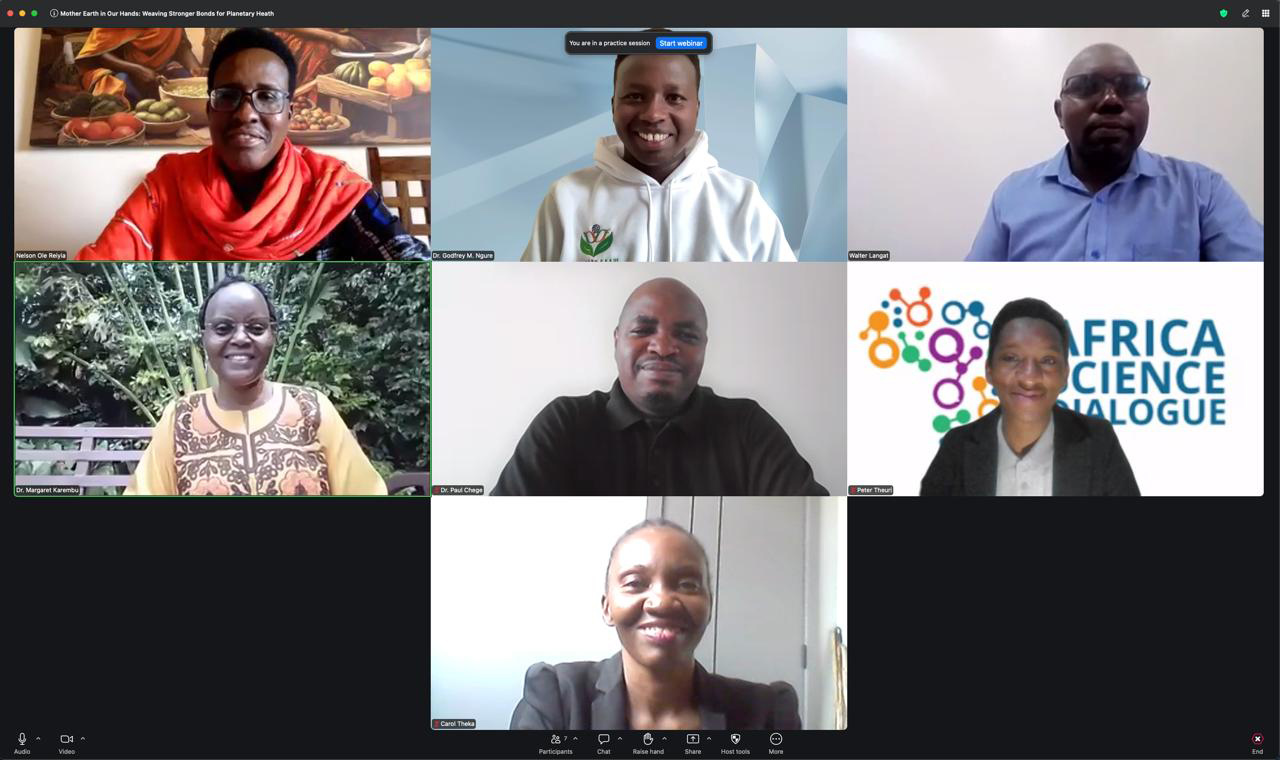
Panelists group photo during a webinar on weaving stronger bonds for Planetary Health on April 22nd, the Earth Day
As the world marked International Mother Earth Day on April 22, 2026, the role of indigenous knowledge and community-led interventions in restoring degraded ecosystems came into sharp focus. During a webinar held to commemorate the day, stakeholders in the environment, conservation, One Health and agriculture called for greater collective responsibility in promoting the well-being of Mother Earth.
Presenting a sobering case from Malawi, Carol Theka, the country’s Principal Environment Officer, illustrated how local communities rose to save Lake Chilwa from the brink of extinction—safeguarding not only their livelihoods but also the diverse bird and aquatic species that depend on the lake.
Lake Chilwa, Malawi’s second-largest lake, once supported approximately 25,000 tonnes of fish annually and hosted 164 bird species, including globally significant waterfowl populations exceeding 354,000 birds. The lake also holds deep cultural significance for the Yao, Chiwa and Nyanja communities.
However, a series of ecological crises threatened its very existence. In 1968, the lake completely dried up due to prolonged drought, resulting in severe food insecurity. Between 1990 and 2005, Malawi lost about 15 percent of its forests, accelerating siltation into the lake. It dried up again in 1995, triggering famine and displacement that affected up to 1.5 million people. Fish stocks also collapsed in the 2000s due to unsustainable practices such as illegal mosquito net fishing, while climate change intensified floods and droughts around 2010, trapping communities in recurring cycles of vulnerability.
“Communities came together, forming 52 village groups, and took custodianship of their resources. They restored forests, regulated fishing, and revived indigenous knowledge systems. Sacred practices, seasonal closures and traditional governance were formally integrated into management,” Theka explained.
She indicated that approximately 1,300 registered bird-hunting associations adopted self-regulation mechanisms to prevent overexploitation, reflecting a growing alignment between traditional governance and conservation science.
Momentum for restoration was further bolstered through the Transform Project, a US$4.4 million initiative supported by the Global Environment Facility and UNDP. The project facilitated wetland rehabilitation, afforestation and livelihood diversification, directly benefiting over 80,000 people and improving the resilience of around 10,000 households.
Theka emphasised that women were at the heart of these interventions, leading ecosystem-based adaptation strategies. Climate resilience measures—including early warning systems, climate-smart agriculture and disaster risk reduction—were embedded across community initiatives, ensuring sustainability beyond short-term recovery.
“Mother Earth has responded remarkably to these interventions. Fish stocks are recovering, riparian forests are regenerating, and water levels have stabilised. About 164 bird species are now protected as the wetland’s ecological character is maintained,” she said.
Lake Chilwa’s success story is mirrored in Kenya, where indigenous-led conservation is similarly reshaping environmental management. The experience of Nashulai Maasai Conservancy in the Maasai Mara offers a compelling example of how local communities can restore ecosystems while preserving cultural heritage.
Situated within a critical wildlife corridor bordering several conservancies in the Mara, Nashulai supports more than 6,000 community members. Prior to its establishment, the area faced challenges including land subdivision, habitat fragmentation, biodiversity loss and disruption of wildlife corridors due to fencing and tourism infrastructure. Over the past two decades, both ecological integrity and cultural heritage had significantly declined, prompting the community to act.
According to Nelson Ole Reiyia, Co-Founder and CEO of Nashulai Conservancy, the community adopted regenerative pastoralism to restore degraded land and re-establish shared commons. This approach led to the establishment of the conservancy as a platform for advancing indigenous nature-based solutions and ecosystem regeneration while preserving cultural practices.
Ole Reiyia explained that Nashulai integrates conservation with economic empowerment through ecosystem stewardship. A community land management fund compensates members for protecting the land, while conservancy enterprises have created over 200 jobs, linking conservation directly to livelihoods.
He further highlighted the establishment of a compensation scheme to address human-wildlife conflict, alongside a shift toward Indigenous-led regenerative tourism that prioritises cultural experiences over extractive models.
“Through the Nashulai model, Maasai women have successfully restored the Sekenani River, part of the Mara River system. Our rivers are life-giving entities that tell stories—they remind us of what we must do to safeguard our future,” he said.
He also highlighted the role of Netiapa, a cultural storytelling centre within the conservancy, where elders pass on Indigenous knowledge to younger generations, complementing modern scientific training.
The discussion culminated in a broader call for integrated action. Margaret Karembu, Director of ISAAA Africenter, urged stakeholders to embrace collaboration and prioritise environmental stewardship as a shared responsibility.
“As we mark International Mother Earth Day, we are reminded that the health of our environment is inseparable from our own well-being—clean air, safe water and fertile soils are not luxuries, but necessities for our survival and prosperity,” she said.
Dr Karembu reminded participants that the choices made today will shape the quality of life for future generations, emphasising that sustainable development must be grounded in both science and indigenous knowledge systems.
The webinar was organised under the auspices of the Africa Science Dialogue and the Capacitating One Health in Eastern and Southern Africa (COHESA) project.