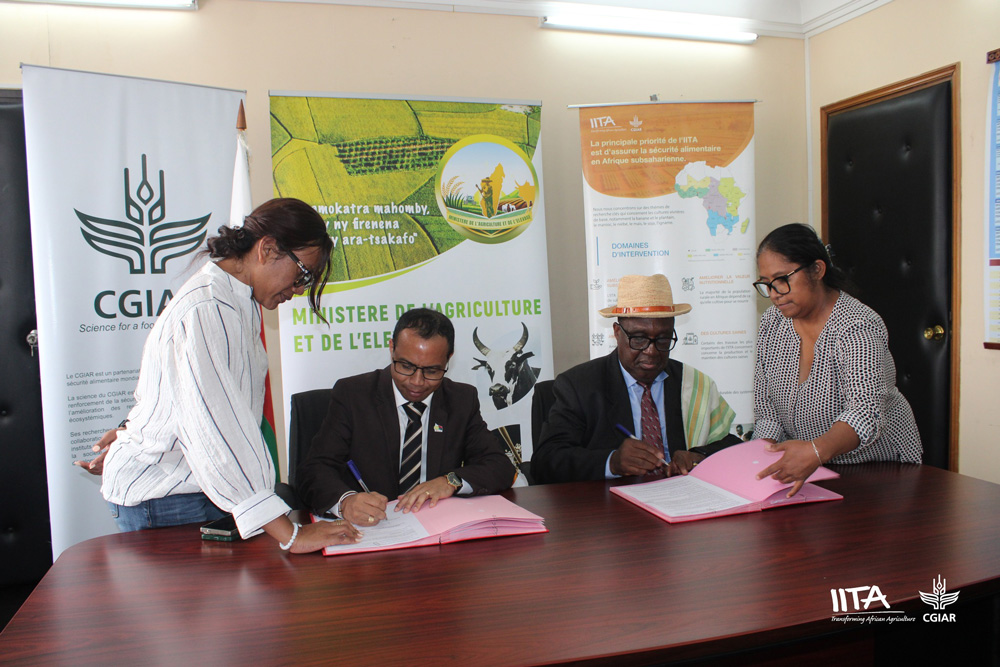
The International Institute of Tropical Agriculture (IITA) on February 27 formalized its presence in Madagascar following the signing of a Headquarters Agreement with the Ministry of Agriculture and Livestock (MINAE) in the country’s capital, Antananarivo.
This agreement grants IITA legal status in the country and sets the stage for long-term, science-driven agricultural investment.
The legal framework now enables IITA to establish sustained scientific programs, forge institutional partnerships, and address Madagascar’s most pressing agricultural challenges arriving at a moment of urgency for the country. Despite significant government investment in the island nation, productivity gains have remained elusive for the 75% of the population that depends on farming.
Interventions such as this agreement have been driven by deliberate efforts, such as a recent government-convened agricultural roundtable that sent a clear message that new partnerships must deliver results that reach farmers’ fields.
IITA Director General Dr. Simeon Ehui, who spoke at the signing ceremony, underscored the Institute’s long-term commitment to the country.
“We are not only here to execute projects,” he said, “but to contribute to the sustainable transformation of Malagasy food systems. This agreement signals our shared commitment to building resilience and prosperity through agriculture.”
With over five decades of experience across sub-Saharan Africa, IITA takes to Madagascar a strong portfolio of innovations in staple crops including banana, cassava, maize, yam, and legumes, improving seed systems and developing varieties that resist pests and adapt to shifting climates.
In some of the places these interventions have been tried, yields have been boosted by as much as 90%.
The partnership will focus on four priority areas: strengthening scientific research and innovation to modernize agriculture; building climate resilience across food systems; advancing digitalization and value chain development; and facilitating technology transfer in alignment with international development agendas, all in close collaboration with Technical and Financial Partners (TFP) and other development agencies.
IITA aims to work alongside other CGIAR centers, national institutions, universities, and extension services to accelerate the adoption of proven technologies and train the next generation of agricultural experts. Climate-smart practices that have already been piloted in other vulnerable regions will be introduced to help farmers manage drought and unpredictable weather. The Institute also places particular emphasis on engaging women and youth who form the backbone of the rural workforce by creating opportunities in agribusiness and value-added processing that make farming a viable and attractive livelihood.
Reflecting on this Institutional milestone, Dr Leena Tripathi, IITA Director for Eastern Africa Hub explained how this partnership will impact the research for development and partnership for Delivery and Scaling.
“This agreement provides an important platform to deepen scientific collaboration and accelerate the delivery of agricultural innovations in Madagascar. Working with national research institutions, universities, and development partners, we aim to scale improved crop varieties, strengthen seed systems, diversify the crops and support the adoption of climate-smart technologies that enhance productivity for farmers across the country.”
Operationally, the Headquarters Agreement streamlines the mobility of scientists and international partners, strengthens joint research initiatives with Malagasy institutions, and provides a stable platform for engagement with government agencies, development partners, and farmer organizations, IITA says.