By Paul Chege, PhD
Fri, Feb 20, 2026
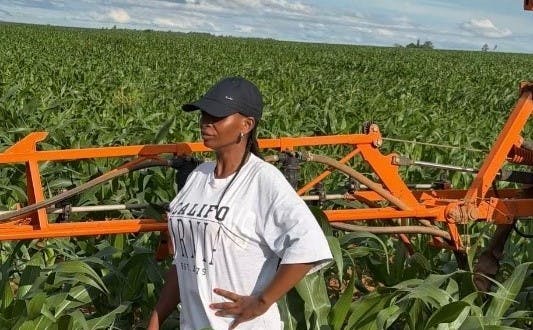
As ISAAA AfriCenter continues its series celebrating women farmers in this Year of the Woman Farmer, we turn our spotlight to a story that powerfully illustrates what happens when determination meets science – and when enabling policies open doors for innovation.
In Tshwane Municipality in Gauteng Province, South Africa, 580 hectares of maize and soybeans stretch across the landscape – a powerful testament to how genetically modified (GM) technology, combined with disciplined agronomy, can accelerate agricultural success. At the heart of this thriving enterprise is 39-year-old Anelly Mokwena, a commercial farmer whose journey reflects both personal determination and the transformative power of modern agricultural tools.
Her growth has been deliberate and strategic. By adopting insect-resistant and herbicide-tolerant maize and soybeans, practicing systematic crop rotation, conducting regular soil testing, and applying precise nutrient correction, Anelly has built a highly efficient farming system that reduces labor costs, protects yields, and enhances predictability. In South Africa, where farmers have access to approved biotechnology products, extension services and structured financing mechanisms, she has leveraged every opportunity to scale responsibly and sustainably.
Anelly’s farm was not always this expansive. In 2016, following the passing of her father, she took over a modest 50-hectare operation. Farming had not been her first choice. There were naysayers too.
“When you are a woman, people doubt you,” she says, recalling the tempestuous early days. Workers tested her authority. Community members questioned her capability. Even within her own circles, there was skepticism about whether she could manage such an enterprise.
Beyond the farm, there were domestic responsibilities – the invisible labor that so often rests on women’s shoulders. Balancing household duties with managing hundreds of hectares required discipline and resilience.
Yet within five years, through careful management and the strategic use of modern seed technologies, she expanded the enterprise nearly tenfold; today she manages 580 hectares with confidence and authority.
Her story is more than one of expansion. It is a story of barriers broken, and of how science, when placed in capable hands, can multiply both harvests and hope. To women in agriculture, and to anyone else who has to contend with doubting eyes from society, she sounds hope.
“You can do it,” she says. “It does not matter whether you are a man or a woman. What matters is dedication, learning and doing things the right way.”