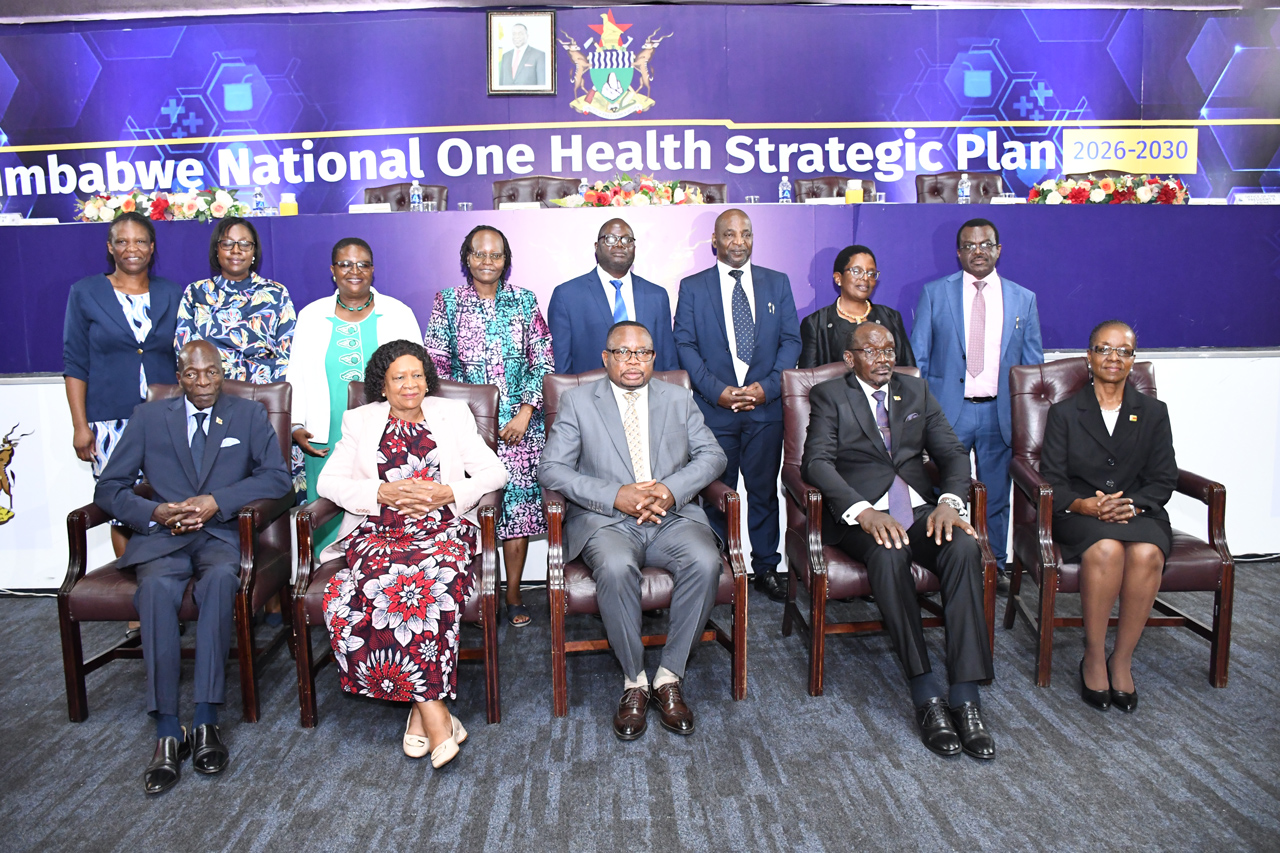
In a bold move, Zimbabwe has launched its National One Health Strategic Plan 2026 -2030, meant to address health threats at the intersection of humans, animals and the environment. This One Health strategy is a clear departure from the previous siloed approach and is meant to strengthen collaboration across sectors, combat endemic and emerging zoonotic diseases, antimicrobial resistance, and other health impacts linked to climate change.
Speaking during the launch, Zimbabwe’s Vice President, Dr. Kembo Mohadi emphasized the need to implement the science-driven, innovative approach to strengthen coordination and collaborations at all levels. “The Zimbabwe National One-Health Strategic Plan 2026–2030 is an innovative and transformative framework that establishes a well-coordinated multi-sectoral approach to tackling health threats facing human, animal, and environmental health,” he said.
The strategy, which runs from 2026 through to 2030, is a culmination of efforts to anchor the One Health approach at the Presidency enabling seamless coordination of line ministries. Dr. Agnes Mahomva, Public Adviser to the President and Cabinet, explains how the shift happened. “When we started, H.E. the President realised that we needed to implement the One Health approach and together with his cabinet, set up a One Health Secretariat back in 2022.”
She noted that the process initially faced challenges because each ministry did not want to be called by another ministry. “When we got that evidence at the Presidency and Cabinet, we decided to step up and take up that coordinating role. We coordinate the three line ministries and other ministries, departments and agencies that have something to do with One Health,” she added.
Behind the scenes, the journey was complex. Dr. Margaret Karembu, Director ISAAA Africenter explains how it all began. “Strategically placing One Health Coordination at the Presidency was not easy. Through Capacitating One Health in Eastern and Southern Africa (COHESA) project partnership, we conducted a net mapping training to understand the connections and relationships among different stakeholders in Zimbabwe. That helped us understand the siloed approach to One Health issues by the different ministries and appreciating that its mandate needed to be anchored at a higher level to effectively convene them.”
“The launch is a huge milestone for the COHESA family across the 12 multiplier African countries,” said Prof. Gift Matope, Dean, Faculty of Veterinary Science, University of Zimbabwe and country Co-PI for COHESA multiplier team. He hailed the commitment and goodwill from the presidency as a key ingredient to realizing the One Health objectives in Zimbabwe.
The result is a strategy that now positions Zimbabwe as a continental leader in institutionalizing One Health with a clear implementation plan. This National One Health Strategic Plan seeks to align with Global Quadripartite One Health Joint Plan of Action, the UN Sustainable Development Goals (SDG), and the National Development Strategy emphasizing on sustainable development, food security, climate resilience and inclusive growth.
As health threats grow increasingly complex and interconnected, Zimbabwe’s model offers a compelling blueprint for African countries seeking to move beyond siloed responses toward coordinated, sustainable solutions